CHAPTER 2 -
METHODOLOGY
One of the impediments identified during an evacuation operation occurring from a natural disaster, is the issue of transportation. The Federal Emergency Management Agency (FEMA) and several other federal, state, and local transportation entities agree that access to reliable transportation is a key factor in a person’s ability to move efficiently to locations of safety.
To address the safety concerns and the state of readiness of smaller urban and rural residents under the threat hurricanes, which do strike on a yearly basis, the proposed study sought to build upon the issue of transportation logistics during an evacuation. Particular emphasis was placed on modeling transit issues unique to an under-represented population residing in a small urban and rural hurricane prone municipality in North Carolina. Both the small urban and rural municipalities served as the bases for identifying needed transit resources and services as well as implementation steps for the successful delivery of these resources and services to an under-represented population, namely the elderly and disable residents.
To achieve
the aforementioned research project, a number of tasks were identified for this
study and the details of each are listed below.
Task
1 - State-of-the-Practice Review
In reviewing the current practice(s) surrounding the subject matter, the research team studied the details involved in planning for hurricane evacuation operations, the application of modeling technologies used in the planning process, and the current transit practice (s) associated with evacuation operations in the State of North Carolina. These practices were compiled and compared to other coastal states as well as the recommended approaches discussed in the literature.
Task
2 - Identify Transit Issues Unique to Hurricane Evacuations
The research team
gathered both quantitative data and qualitative information on existing
demographic, infrastructure and geographic data to name few. This data as it relates to hurricane
evacuation operations was compiled and organized for use in Task 5. While
formal interviews were not solicited nor conducted, local anecdotes from
citizens and officials were not discouraged either.
Task
3 - Develop Site Selection Criteria
To facilitate the selection of sites, a set of criterion were developed in the context of addressing human and transit resources and services used as well as needed during an evacuation operation. Elements of the criteria included the identification of characteristics that define small urban and rural municipalities; existing dispersion vs. concentration of transit provider net- work; and existing dispersion vs. concentration of the under-represented population to name a few.
Task
4 - Identification and Selection of Sites
Two
hurricane-prone areas were selected, one small urban and one rural, as case
studies and for gaining a more in-depth understanding of the residents and
transit needs during a hurricane evacuation as well as for modeling purposes. It was important for the selected sites to
be reasonably representative of other small urban and rural areas of the State
in order to get good impression of the magnitude of the problem.
This process determined how the sites were selected.
Task
5 - Modeling Assessment
A traffic
operations based hurricane evacuation model was employed to analyze the
selected sites by simulating a variety of evacuation scenario activities based
on quantitative data collected in Task 2.
Particularly, the use of existing transit facilities and public fleets
was considered. In addition, a
combination of readily available technologies such as global position systems
(GPS) and dynamic vehicle routing and management were investigated. Other tools such as Geographic Information
Systems (GIS) were also studied for flood extent estimations. The results from
the various evacuation scenarios were then assessed.
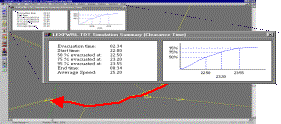
Figure 2.1 - Hurricane Evacuation Model Screen Display
Task
6 - Evaluation of Modeling Activities
Evaluation mechanisms were established to
assess the validity of the model results and integration of new
technologies. Several necessary
elements were evaluated and the following were suggested: identifying future
needs of the selected sites in terms of evacuation planning and operations;
protocol structure of a demand responsive service; transit provider
performances; cost-effectiveness of evacuation plans and alternatives; and
accessibility to the under-represented population to name a few.
Task
7 - New Technologies Assessment
An assessment of intelligent transportation system (ITS) technologies that can benefit hurricane evacuation operations was conducted. The research team identified ITS technologies that could augment initiatives deployed by North Carolina’s Department of Transportation. Recommendations were made on how to integrate these advanced technologies into the results from Task 5, thus improving the mobility and accessibility of elderly and disable citizens during a time of an evacuation.
Task
8 - Documentation and Recommendations
The results from
the previous tasks are detailed in the following chapters, and will be
submitted to North Carolina A&T State University's Transportation
Institute, and may be submitted for publication and/or conference presentation. The report suggests a methodology for
addressing the transit issues unique to hurricane evacuation of elderly and
disable residents of small urban and rural areas. If deemed beneficial, the findings may be shared through
technology transfer activities such as continuing education and training
courses suggested herein.